MoreExam
1. Question Content...
EXPLANATION
Answer: X - EXPLANATION Content.
Question1: You are creating a CI/CD pipeline to perform Terraform deployments of Google Cloud resources Your CI/CD tooling is running in Google Kubernetes Engine (GKE) and uses an ephemeral Pod for each pipeline run You must ensure that the pipelines that run in the Pods have the appropriate Identity and Access Management (1AM) permissions to perform the Terraform deployments You want to follow Google-recommended practices for identity management What should you do?Choose 2 answers
Question2: You built a serverless application by using Cloud Run and deployed the application to your production environment You want to identify the resource utilization of the application for cost optimization What should you do?
Question3: You use Spinnaker to deploy your application and have created a canary deployment stage in the pipeline. Your application has an in-memory cache that loads objects at start time. You want to automate the comparison of the canary version against the production version. How should you configure the canary analysis?
Question4: Your CTO has asked you to implement a postmortem policy on every incident for internal use. You want to define what a good postmortem is to ensure that the policy is successful at your company. What should you do?Choose 2 answers
Question5: Your team is designing a new application for deployment into Google Kubernetes Engine (GKE). You need to set up monitoring to collect and aggregate various application-level metrics in a centralized location. You want to use Google Cloud Platform services while minimizing the amount of work required to set up monitoring. What should you do?
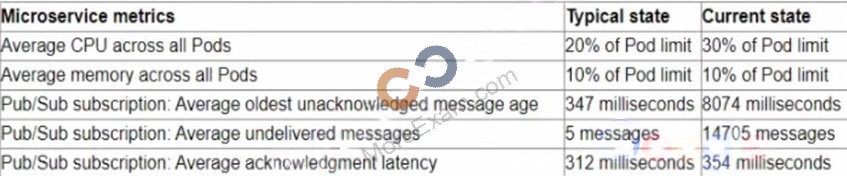
Question6: You are the on-call Site Reliability Engineer for a microservice that is deployed to a Google Kubernetes Engine (GKE) Autopilot cluster. Your company runs an online store that publishes order messages to Pub/Sub and a microservice receives these messages and updates stock information in the warehousing system. A sales event caused an increase in orders, and the stock information is not being updated quickly enough. This is causing a large number of orders to be accepted for products that are out of stock You check the metrics for the microservice and compare them to typical levels.You need to ensure that the warehouse system accurately reflects product inventory at the time orders are placed and minimize the impact on customers What should you do?
Question7: You support a trading application written in Python and hosted on App Engine flexible environment. You want to customize the error information being sent to Stackdriver Error Reporting. What should you do?
Question8: You support an application running on App Engine. The application is used globally and accessed from various device types. You want to know the number of connections. You are using Stackdriver Monitoring for App Engine. What metric should you use?
Question9: You recently noticed that one Of your services has exceeded the error budget for the current rolling window period. Your company's product team is about to launch a new feature. You want to follow Site Reliability Engineering (SRE) practices.What should you do?
Question10: Some of your production services are running in Google Kubernetes Engine (GKE) in the eu-west-1 region. Your build system runs in the us-west-1 region. You want to push the container images from your build system to a scalable registry to maximize the bandwidth for transferring the images to the cluster. What should you do?
Question11: You are building and deploying a microservice on Cloud Run for your organization Your service is used by many applications internally You are deploying a new release, and you need to test the new version extensively in the staging and production environments You must minimize user and developer impact. What should you do?
Question12: You support an application deployed on Compute Engine. The application connects to a Cloud SQL instance to store and retrieve dat a. After an update to the application, users report errors showing database timeout messages. The number of concurrent active users remained stable. You need to find the most probable cause of the database timeout. What should you do?
Question13: You have a pool of application servers running on Compute Engine. You need to provide a secure solution that requires the least amount of configuration and allows developers to easily access application logs for troubleshooting. How would you implement the solution on GCP?
Question14: Your applications performance in Google Cloud has degraded since the last release You suspect that downstream dependencies might be causing some requests to take longer to complete You need to investigate the issue with your application to determine the cause What should you do?
Question15: You are performing a semi-annual capacity planning exercise for your flagship service You expect a service user growth rate of 10% month-over-month for the next six months Your service is fully containerized and runs on a Google Kubemetes Engine (GKE) standard cluster across three zones with cluster autoscaling enabled You currently consume about 30% of your total deployed CPU capacity and you require resilience against the failure of a zone. You want to ensure that your users experience minimal negative impact as a result of this growth o' as a result of zone failure while you avoid unnecessary costs How should you prepare to handle the predicted growth?
Question16: You support a popular mobile game application deployed on Google Kubernetes Engine (GKE) across several Google Cloud regions. Each region has multiple Kubernetes clusters. You receive a report that none of the users in a specific region can connect to the application. You want to resolve the incident while following Site Reliability Engineering practices. What should you do first?
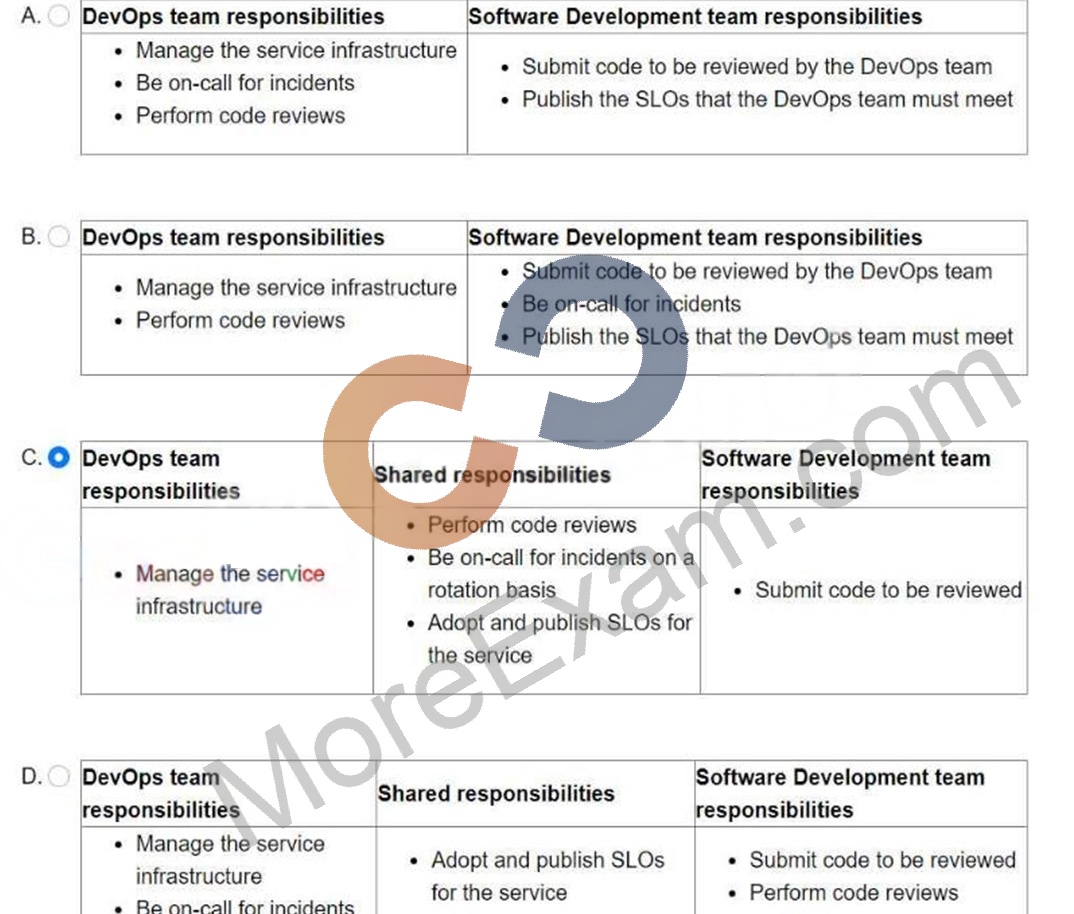
Question17: You are leading a DevOps project for your organization. The DevOps team is responsible for managing the service infrastructure and being on-call for incidents. The Software Development team is responsible for writing, submitting, and reviewing code. Neither team has any published SLOs. You want to design a new joint-ownership model for a service between the DevOps team and the Software Development team. Which responsibilities should be assigned to each team in the new joint-ownership model?
Question18: You are configuring connectivity across Google Kubernetes Engine (GKE) clusters in different VPCs You notice that the nodes in Cluster A are unable to access the nodes in Cluster B You suspect that the workload access issue is due to the network configuration You need to troubleshoot the issue but do not have execute access to workloads and nodes You want to identify the layer at which the network connectivity is broken What should you do?
Question19: You use Terraform to manage an application deployed to a Google Cloud environment The application runs on instances deployed by a managed instance group The Terraform code is deployed by using a CI/CD pipeline When you change the machine type on the instance template used by the managed instance group, the pipeline fails at the terraform apply stage with the following error messageYou need to update the instance template and minimize disruption to the application and the number of pipeline runs What should you do?
Question20: Your uses Jenkins running on Google Cloud VM instances for CI/CD. You need to extend the functionality to use infrastructure as code automation by using Terraform. You must ensure that the Terraform Jenkins instance is authorized to create Google Cloud resources. You want to follow Google-recommended practices- What should you do?
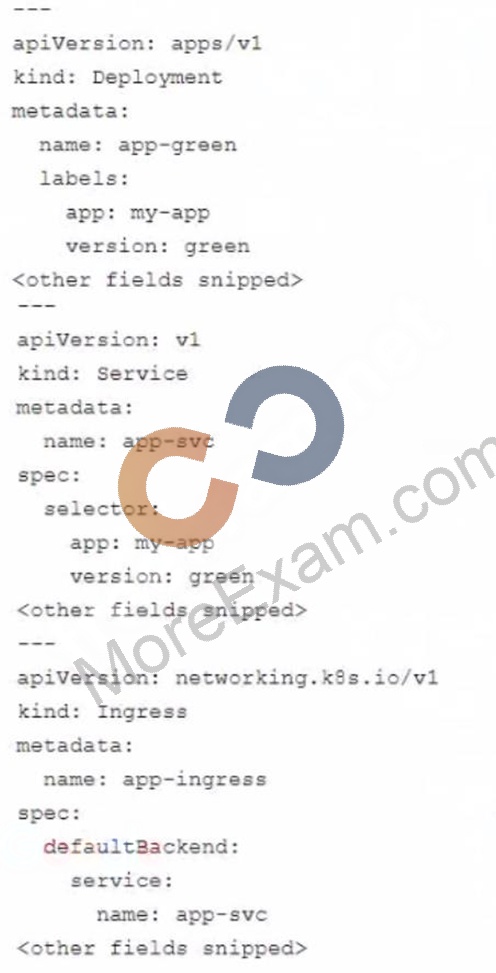
Question21: You manage an application that runs in Google Kubernetes Engine (GKE) and uses the blue/green deployment methodology Extracts of the Kubernetes manifests are shown belowThe Deployment app-green was updated to use the new version of the application During post-deployment monitoring you notice that the majority of user requests are failing You did not observe this behavior in the testing environment You need to mitigate the incident impact on users and enable the developers to troubleshoot the issue What should you do?
Question22: You support a service that recently had an outage. The outage was caused by a new release that exhausted the service memory resources. You rolled back the release successfully to mitigate the impact on users. You are now in charge of the post-mortem for the outage. You want to follow Site Reliability Engineering practices when developing the post-mortem. What should you do?
Question23: You need to reduce the cost of virtual machines (VM| for your organization. After reviewing different options, you decide to leverage preemptible VM instances. Which application is suitable for preemptible VMs?
Question24: You need to enforce several constraint templates across your Google Kubernetes Engine (GKE) clusters. The constraints include policy parameters, such as restricting the Kubernetes API. You must ensure that the policy parameters are stored in a GitHub repository and automatically applied when changes occur. What should you do?
Question25: You are configuring a Cl pipeline. The build step for your Cl pipeline integration testing requires access to APIs inside your private VPC network. Your security team requires that you do not expose API traffic publicly. You need to implement a solution that minimizes management overhead. What should you do?
Question26: Your organization wants to increase the availability target of an application from 99 9% to 99 99% for an investment of $2 000 The application's current revenue is S1,000,000 You need to determine whether the increase in availability is worth the investment for a single year of usage What should you do?
Question27: You support a service with a well-defined Service Level Objective (SLO). Over the previous 6 months, your service has consistently met its SLO and customer satisfaction has been consistently high. Most of your service's operations tasks are automated and few repetitive tasks occur frequently. You want to optimize the balance between reliability and deployment velocity while following site reliability engineering best practices. What should you do? (Choose two.)
Question28: You encountered a major service outage that affected all users of the service for multiple hours. After several hours of incident management, the service returned to normal, and user access was restored. You need to provide an incident summary to relevant stakeholders following the Site Reliability Engineering recommended practices. What should you do first?
Question29: You are investigating issues in your production application that runs on Google Kubernetes Engine (GKE). You determined that the source Of the issue is a recently updated container image, although the exact change in code was not identified. The deployment is currently pointing to the latest tag. You need to update your cluster to run a version of the container that functions as intended. What should you do?
Question30: Your organization has a containerized web application that runs on-premises As part of the migration plan to Google Cloud you need to select a deployment strategy and platform that meets the following acceptance criteria1 The platform must be able to direct traffic from Android devices to an Android-specific microservice2 The platform must allow for arbitrary percentage-based traffic splitting3 The deployment strategy must allow for continuous testing of multiple versions of any microservice What should you do?
Question31: Your application services run in Google Kubernetes Engine (GKE). You want to make sure that only images from your centrally-managed Google Container Registry (GCR) image registry in the altostrat-images project can be deployed to the cluster while minimizing development time. What should you do?
Question32: You are building and running client applications in Cloud Run and Cloud Functions Your client requires that all logs must be available for one year so that the client can import the logs into their logging service You must minimize required code changes What should you do?
Question33: You support an application running on GCP and want to configure SMS notifications to your team for the most critical alerts in Stackdriver Monitoring. You have already identified the alerting policies you want to configure this for. What should you do?
Question34: Your development team has created a new version of their service's API. You need to deploy the new versions of the API with the least disruption to third-party developers and end users of third-party installed applications. What should you do?
Question35: You need to deploy a new service to production. The service needs to automatically scale using a Managed Instance Group (MIG) and should be deployed over multiple regions. The service needs a large number of resources for each instance and you need to plan for capacity. What should you do?
Question36: Your organization wants to collect system logs that will be used to generate dashboards in Cloud Operations for their Google Cloud project. You need to configure all current and future Compute Engine instances to collect the system logs and you must ensure that the Ops Agent remains up to date. What should you do?
Question37: You currently store the virtual machine (VM) utilization logs in Stackdriver. You need to provide an easy-to-share interactive VM utilization dashboard that is updated in real time and contains information aggregated on a quarterly basis. You want to use Google Cloud Platform solutions. What should you do?
Question38: You need to build a CI/CD pipeline for a containerized application in Google Cloud Your development team uses a central Git repository for trunk-based development You want to run all your tests in the pipeline for any new versions of the application to improve the quality What should you do?
Question39: A third-party application needs to have a service account key to work properly When you try to export the key from your cloud project you receive an error "The organization policy constraint larn.disableServiceAccountKeyCreation is enforcedM You need to make the third-party application work while following Google-recommended security practices What should you do?
Question40: You are deploying a Cloud Build job that deploys Terraform code when a Git branch is updated. While testing, you noticed that the job fails. You see the following error in the build logs:Initializing the backend. ..Error: Failed to get existing workspaces : querying Cloud Storage failed: googleapi : Error403You need to resolve the issue by following Google-recommended practices. What should you do?
Question41: Your product is currently deployed in three Google Cloud Platform (GCP) zones with your users divided between the zones. You can fail over from one zone to another, but it causes a 10-minute service disruption for the affected users. You typically experience a database failure once per quarter and can detect it within five minutes. You are cataloging the reliability risks of a new real-time chat feature for your product. You catalog the following information for each risk:* Mean Time to Detect (MUD} in minutes* Mean Time to Repair (MTTR) in minutes* Mean Time Between Failure (MTBF) in days* User Impact PercentageThe chat feature requires a new database system that takes twice as long to successfully fail over between zones. You want to account for the risk of the new database failing in one zone. What would be the values for the risk of database failover with the new system?
Question42: You need to define SLOs for a high-traffic web application. Customers are currently happy with the application performance and availability. Based on current measurement, the 90th percentile Of latency is 160 ms and the 95th percentile of latency is 300 ms over a 28-day window. What latency SLO should you publish?
Question43: Your company operates in a highly regulated domain that requires you to store all organization logs for seven years You want to minimize logging infrastructure complexity by using managed services You need to avoid any future loss of log capture or stored logs due to misconfiguration or human error What should you do?
Question44: You are responsible for the reliability of a high-volume enterprise application. A large number of users report that an important subset of the application's functionality - a data intensive reporting feature - is consistently failing with an HTTP 500 error. When you investigate your application's dashboards, you notice a strong correlation between the failures and a metric that represents the size of an internal queue used for generating reports. You trace the failures to a reporting backend that is experiencing high I/O wait times. You quickly fix the issue by resizing the backend's persistent disk (PD). How you need to create an availability Service Level Indicator (SLI) for the report generation feature. How would you define it?
Question45: Your company follows Site Reliability Engineering principles. You are writing a postmortem for an incident, triggered by a software change, that severely affected users. You want to prevent severe incidents from happening in the future. What should you do?
Question46: You encounter a large number of outages in the production systems you support. You receive alerts for all the outages that wake you up at night. The alerts are due to unhealthy systems that are automatically restarted within a minute. You want to set up a process that would prevent staff burnout while following Site Reliability Engineering practices. What should you do?
Question47: Your company operates in a highly regulated domain. Your security team requires that only trusted container images can be deployed to Google Kubernetes Engine (GKE). You need to implement a solution that meets the requirements of the security team, while minimizing management overhead. What should you do?
Question48: Your company runs applications in Google Kubernetes Engine (GKE) that are deployed following a GitOps methodology.Application developers frequently create cloud resources to support their applications. You want to give developers the ability to manage infrastructure as code, while ensuring that you follow Google-recommended practices. You need to ensure that infrastructure as code reconciles periodically to avoid configuration drift. What should you do?
Question49: Your company runs services by using multiple globally distributed Google Kubernetes Engine (GKE) clusters Your operations team has set up workload monitoring that uses Prometheus-based tooling for metrics alerts: and generating dashboards This setup does not provide a method to view metrics globally across all clusters You need to implement a scalable solution to support global Prometheus querying and minimize management overhead What should you do?
Question50: You support a high-traffic web application that runs on Google Cloud Platform (GCP). You need to measure application reliability from a user perspective without making any engineering changes to it. What should you do?Choose 2 answers
Question51: You use Cloud Build to build your application. You want to reduce the build time while minimizing cost and development effort. What should you do?
Question52: Your organization wants to implement Site Reliability Engineering (SRE) culture and principles. Recently, a service that you support had a limited outage. A manager on another team asks you to provide a formal explanation of what happened so they can action remediations. What should you do?
Question53: You are analyzing Java applications in production. All applications have Cloud Profiler and Cloud Trace installed and configured by default. You want to determine which applications need performance tuning. What should you do?Choose 2 answers
Question54: You deploy a new release of an internal application during a weekend maintenance window when there is minimal user traffic. After the window ends, you learn that one of the new features isn't working as expected in the production environment. After an extended outage, you roll back the new release and deploy a fix. You want to modify your release process to reduce the mean time to recovery so you can avoid extended outages in the future. What should you do?Choose 2 answers
Question55: Your team of Infrastructure DevOps Engineers is growing, and you are starting to use Terraform to manage infrastructure. You need a way to implement code versioning and to share code with other team members. What should you do?
Question56: You are running a real-time gaming application on Compute Engine that has a production and testing environment. Each environment has their own Virtual Private Cloud (VPC) network. The application frontend and backend servers are located on different subnets in the environment's VPC. You suspect there is a malicious process communicating intermittently in your production frontend servers. You want to ensure that network traffic is captured for analysis. What should you do?
Question57: You need to run a business-critical workload on a fixed set of Compute Engine instances for several months. The workload is stable with the exact amount of resources allocated to it. You want to lower the costs for this workload without any performance implications. What should you do?
Question58: You are developing a strategy for monitoring your Google Cloud Platform (GCP) projects in production using Stackdriver Workspaces. One of the requirements is to be able to quickly identify and react to production environment issues without false alerts from development and staging projects. You want to ensure that you adhere to the principle of least privilege when providing relevant team members with access to Stackdriver Workspaces. What should you do?
Question59: You support a large service with a well-defined Service Level Objective (SLO). The development team deploys new releases of the service multiple times a week. If a major incident causes the service to miss its SLO, you want the development team to shift its focus from working on features to improving service reliability. What should you do before a major incident occurs?
Question60: You are creating a CI/CD pipeline in Cloud Build to build an application container image The application code is stored in GitHub Your company requires thai production image builds are only run against the main branch and that the change control team approves all pushes to the main branch You want the image build to be as automated as possible What should you do?Choose 2 answers
Question61: You are developing reusable infrastructure as code modules. Each module contains integration tests that launch the module in a test project. You are using GitHub for source control. You need to Continuously test your feature branch and ensure that all code is tested before changes are accepted. You need to implement a solution to automate the integration tests. What should you do?
Question62: Your Cloud Run application writes unstructured logs as text strings to Cloud Logging. You want to convert the unstructured logs to JSON-based structured logs. What should you do?
Question63: You have migrated an e-commerce application to Google Cloud Platform (GCP). You want to prepare the application for the upcoming busy season. What should you do first to prepare for the busy season?
Question64: You work for a global organization and run a service with an availability target of 99% with limited engineering resources. For the current calendar month you noticed that the service has 99 5% availability. You must ensure that your service meets the defined availability goals and can react to business changes including the upcoming launch of new features You also need to reduce technical debt while minimizing operational costs You want to follow Google-recommended practices What should you do?
Question65: You deployed an application into a large Standard Google Kubernetes Engine (GKE) cluster. The application is stateless and multiple pods run at the same time. Your application receives inconsistent traffic. You need to ensure that the user experience remains consistent regardless of changes in traffic. and that the resource usage of the cluster is optimized.What should you do?
Question66: Your company has a Google Cloud resource hierarchy with folders for production test and development Your cyber security team needs to review your company's Google Cloud security posture to accelerate security issue identification and resolution You need to centralize the logs generated by Google Cloud services from all projects only inside your production folder to allow for alerting and near-real time analysis. What should you do?
Question67: You support a Node.js application running on Google Kubernetes Engine (GKE) in production. The application makes several HTTP requests to dependent applications. You want to anticipate which dependent applications might cause performance issues. What should you do?
Question68: You are the Operations Lead for an ongoing incident with one of your services. The service usually runs at around 70% capacity. You notice that one node is returning 5xx errors for all requests. There has also been a noticeable increase in support cases from customers. You need to remove the offending node from the load balancer pool so that you can isolate and investigate the node. You want to follow Google-recommended practices to manage the incident and reduce the impact on users. What should you do?
Question69: You are deploying an application that needs to access sensitive information. You need to ensure that this information is encrypted and the risk of exposure is minimal if a breach occurs. What should you do?
Question70: You support a high-traffic web application and want to ensure that the home page loads in a timely manner. As a first step, you decide to implement a Service Level Indicator (SLI) to represent home page request latency with an acceptable page load time set to 100 ms. What is the Google-recommended way of calculating this SLI?
Question71: You manage several production systems that run on Compute Engine in the same Google Cloud Platform (GCP) project. Each system has its own set of dedicated Compute Engine instances. You want to know how must it costs to run each of the systems. What should you do?